def forward(self, x): x = self.conv(x) x = F.relu(x) x = F.max_pool2d(x, 2) x = self.dropout(x) x = torch.flatten(x, 1) x = self.fc(x) output = F.log_softmax(x, dim=1) return output
# Define image transform transform=transforms.Compose([ transforms.ToTensor(), transforms.Normalize((0.1307,), (0.3081,)) # mean and std for the MNIST training set ])
# Save and load model torch.save(model.state_dict(), "mnist_cnn.pt") model = Net() model.load_state_dict(torch.load("mnist_cnn.pt"))
# Test test(model, test_loader)
训练参数储存
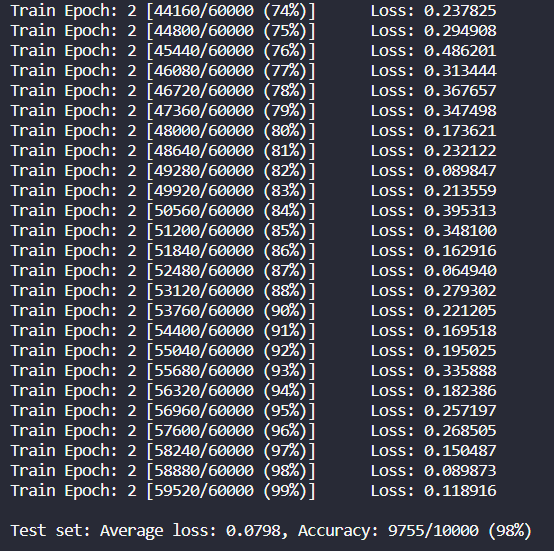
e)训练结果
3.FGSM攻击
a)模型加载
加载模型
1 2 3 4 5 6 7 8 9 10 11 12 13 14 15 16 17 18 19
# MNIST Test dataset and dataloader declaration
transform = transforms.Compose([
            transforms.ToTensor(),
            ])
train_dataset = datasets.MNIST('./data', train=True, download=True,
                    transform=transform)
test_loader = torch.utils.data.DataLoader(train_dataset,batch_size=1, shuffle=True)
# Define what device we are using
print("CUDA Available: ",torch.cuda.is_available())
device = torch.device("cuda" if (use_cuda and torch.cuda.is_available()) else "cpu")

# Initialize the network
model = Net().to(device)

# Load the pretrained model
model.load_state_dict(torch.load("mnist_cnn.pt", map_location='cpu'))

# Set the model in evaluation mode. In this case this is for the Dropout layers
model.eval()
b)攻击函数创建
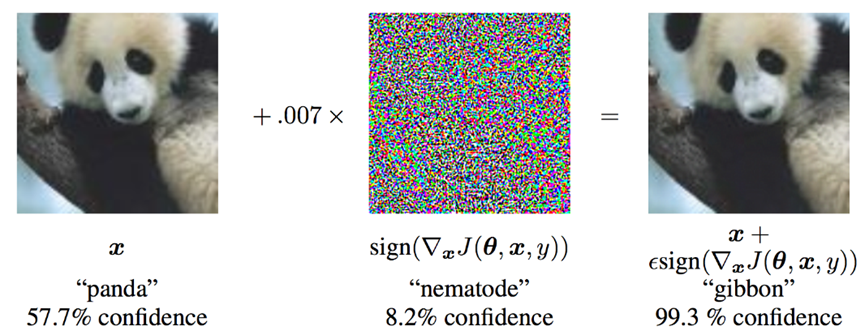
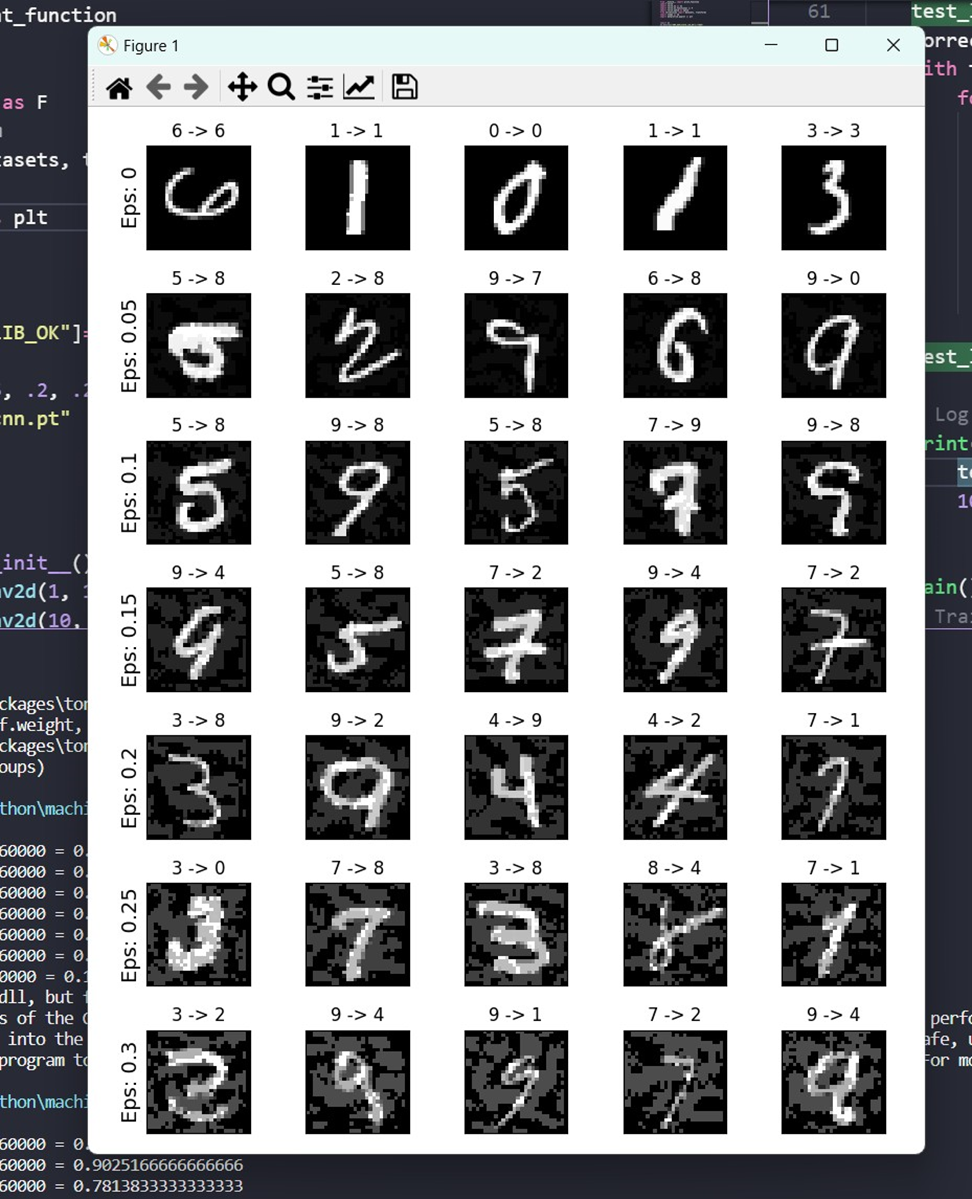
现在,我们可以通过扰动原始输入来定义创建对抗性示例的函数。Fgsm 攻击函数有三个输入,图像是原始清晰图像(xx) ,ε 是像素级扰动量(εε) ,data _ grad 是损失的梯度,输入图像(∇xJ(θ,x,y))。然后,该函数创建扰动图像 $$ perturbed_image=image+epsilon∗sign(data_grad)=x+ϵ∗sign(∇ x J(θ,x,y)) $$
1
2
3
4
5
6
7
8
9
10
# FGSM attack code
def fgsm_attack(image, epsilon, data_grad):
    # Collect the element-wise sign of the data gradient
    sign_data_grad = data_grad.sign()
    # Create the perturbed image by adjusting each pixel of the input image
    perturbed_image = image + epsilon*sign_data_grad
    # Adding clipping to maintain [0,1] range
    perturbed_image = torch.clamp(perturbed_image, 0, 1)
    # Return the perturbed image
    return perturbed_image
c)开始攻击
1
2
3
4
5
6
7
8
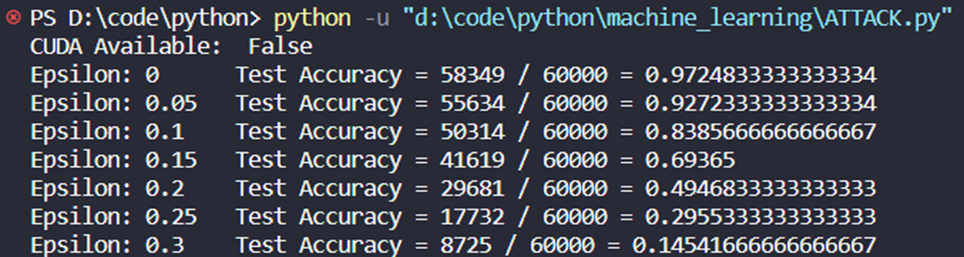
accuracies = []
examples = []

# Run test for each epsilon
for eps in epsilons:
    acc, ex = test(model, device, test_loader, eps)
    accuracies.append(acc)
    examples.append(ex)
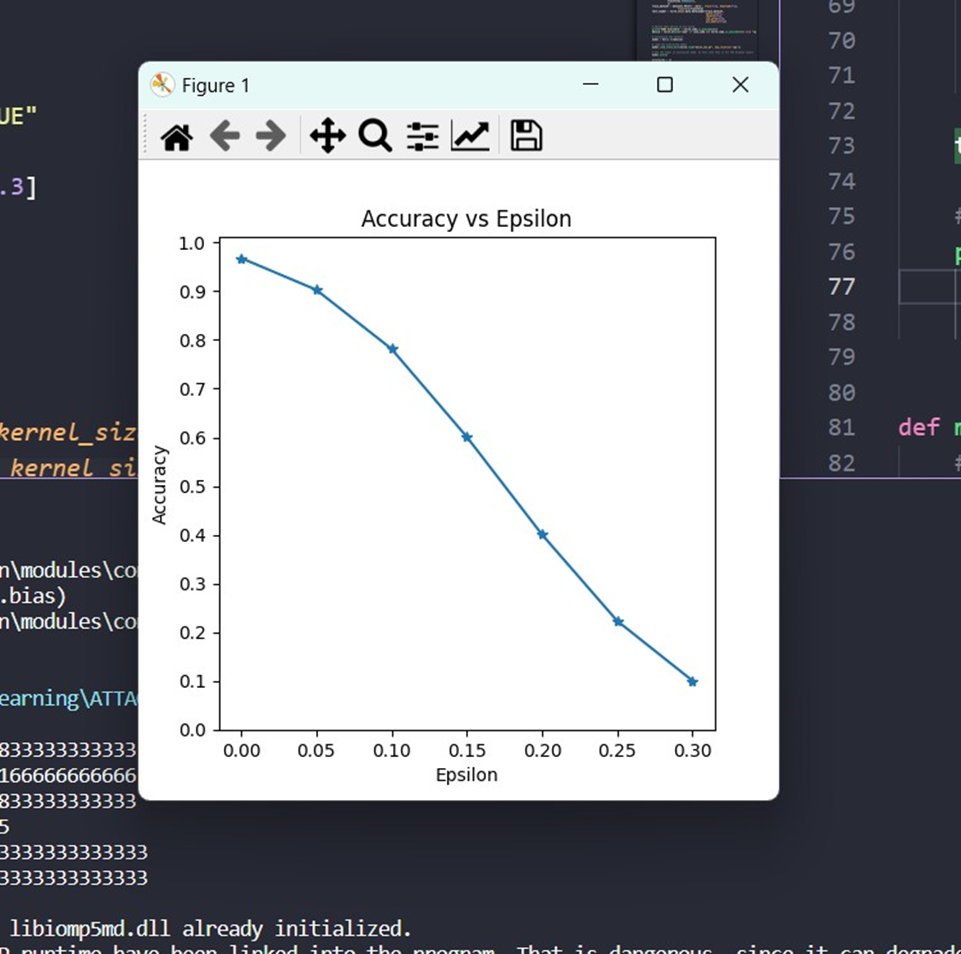
# Plot several examples of adversarial samples at each epsilon
 cnt = 0
 plt.figure(figsize=(8,10))
 for i in range(len(epsilons)):
     for j in range(len(examples[i])):
         cnt += 1
         plt.subplot(len(epsilons),len(examples[0]),cnt)
         plt.xticks([], [])
         plt.yticks([], [])
         if j == 0:
             plt.ylabel("Eps: {}".format(epsilons[i]), fontsize=14)
         orig,adv,ex = examples[i][j]
         plt.title("{} -> {}".format(orig, adv))
         plt.imshow(ex, cmap="gray")
 plt.tight_layout()
 plt.show()